009: Grief is for everyone
Why I write about my mom, someone's dead wife named Terry, and how the algorithm makes us buy fewer tickets. It's all connected. Trust me.
~~~
tl;dr at the end because I got riled up and wrote 3000 words. But I think it’s worth reading the whole thing!
Okay.
You know what? Let’s just jump right into this. The other day I was on Threads (Instagram’s version of Twitter. If you know you know. And if you don’t know, stay blissfully unaware). I came across this post.
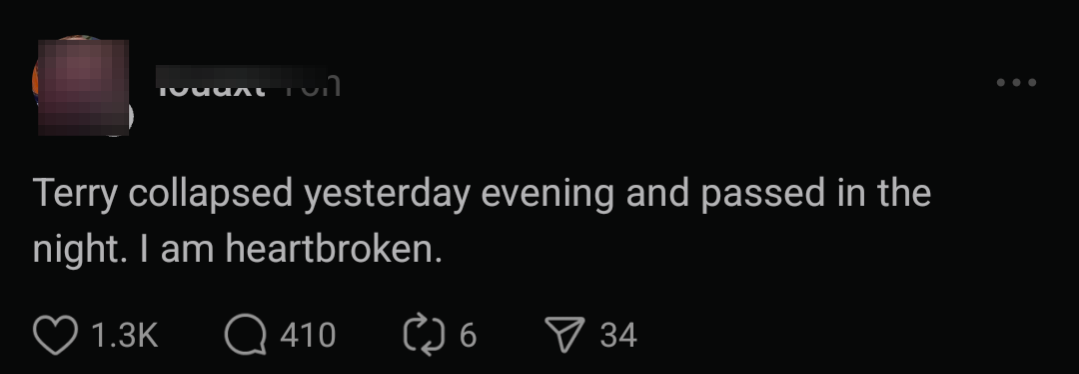
The person who posted it has fewer than 500 followers. I’m assuming that he knows most, if not all of them. But as I have very unfortunately discovered, it’s easy to accidentally go small-scale viral on Threads. It’s something that’s pretty unusual on other platforms – most of the time, your posts are only shown to the people who follow you, not thousands of strangers.
In my brief time on the app, I’ve gone mini-viral a handful of times, and it’s always a nightmare due to the hatred & negativity that inevitably arrives. I’ve gone viral for:
Saying that it costs me at least $1000 to produce a song. This ended with a few dozen people telling me that women shouldn’t make music if we’re so stupid we can’t learn to mix and master via YouTube (?!?)
Sharing a story of being harassed in the gym. This ended with rape and death threats, accusations of wearing “lingerie” to the gym (a longline sports bra??), and people telling me I made it up for attention.
Sharing that I was surprised the crew of the boat that crashed into a bridge in Baltimore was still on board the ship 2 months later. That ended with people saying I’m an idiot and know nothing about immigration, that I’m representative of everything that’s wrong with the American educational system, and I’m heartless for not acknowledging the people who died in that accident. (Honorable mention to the commenter who unironically berated me for “clearly knowing NOTHING about maritime law.” ok, guy!)
And more!!!!!!!!
There’s a clear pattern of people being absolutely stupid, and when it’s happened to me, it gets me really upset. But recently, I saw it happen to this person whose post I shared above, and I had enough distance to understand what’s going on on his post, and how it relates to two important things in my life:
Our cultural conversation around grief.
The general reluctance to buy tickets to shows.
Bear with me, here.
I’ve been writing about my mom nonstop since she died over three years ago.
I’ve published several essays about her, and I’ve also completed a memoir manuscript about grief, mental health, and mother-daughter relationships. But even before I lost my mom, I’ve always had a preoccupation with death, the rituals around death and dying, and rituals of memorialization.
I mean, I grew up with a grandmother who had a wreath made from her dead sister’s hair – which is both as beautiful and as macabre as it sounds – see some Victorian hair art here, as well as people reviving the art form. When my mom died, I considered taking a formal Victorian-style year of mourning, because I felt so unmoored in a society and culture that seeks to erase any evidence of death and loss as quickly as possible.
I took eight days off of work. I played a show 12 days after she died. I spent two days on set working on a film project two weeks after she was gone. The more conflict-and-negativity-avoidant of my friends stopped asking me how I was doing as quickly as possible; stored my mother’s death in some file labeled Past and Dealt With.
In reality, I am still so ill from her death. I am still unable to attend memorials and funerals without taking days to recover. I saw a skull-shaped cup at a bar and I went to the bathroom to heave over the toilet. I weave marigold garlands and I think of the people I’ve lost. I open my eyes each morning and I still have to whisper my mother is dead and she’s not coming back to myself or I’ll pick up my phone to text her. I still feel like I’m living in a world parallel to the one where my friends live. That we’re separated by a thin pane of glass that only I’m aware of, because they won’t come close enough to see that it’s there.
You know, regular-degular grief stuff.
When I had a Jewish friend lose a family member, I was entranced by (and jealous of!) the ritual associated with the death. The people in the house, the short number of days before the interment, the marking of the first year. There was a sense of collectivity and ancient routine – that Jews for thousands of years had wept and prayed and mourned and buried in the same ways, creating a lineage that stretched into the present day and will continue to reach into the future.
Another friend, from another country, but living in the US, lost a family member and they decried the American stoicism expected around death. “In my country,” they said, “the family would be screaming in the streets and tearing their clothes. They would hardly be able to walk, and everyone around them would lift them by their arms as the body was brought to the pyre. Everyone would weep with the family, screaming and shouting and falling on the ground.”
It made me think of the strange math that I became obsessed with right after losing my mom: I kept thinking, I knew her for 28 years. So I must grieve for her for 28 years. I felt like I needed to ruin my own life to show how much her loss destroyed me. When I experienced joy, I felt shame. She sacrificed and struggled and gave so much to be my mother – why couldn’t I give her just 28 years of complete and utter suffering to show her that it meant something to me? How could I possibly ‘move on’ in a year or three?
Many people have asked me why I wanted to write a book about my mom. I’ll come back to that soon. It’s all connected, trust me.
So this poor man on Threads loses someone named Terry. Here’s what the people had to say.
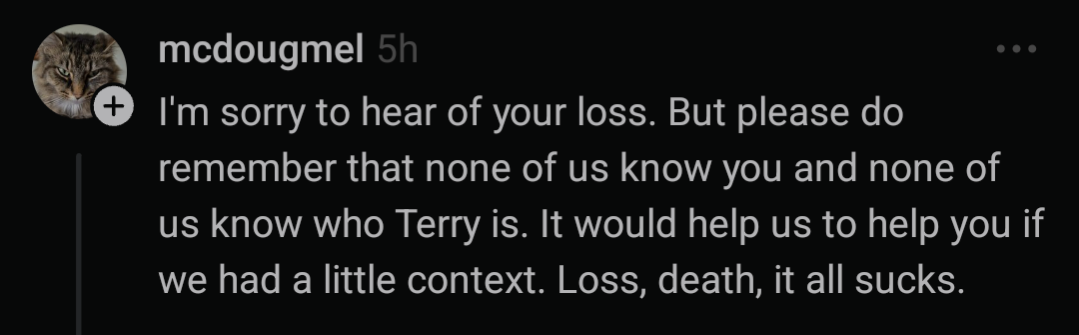
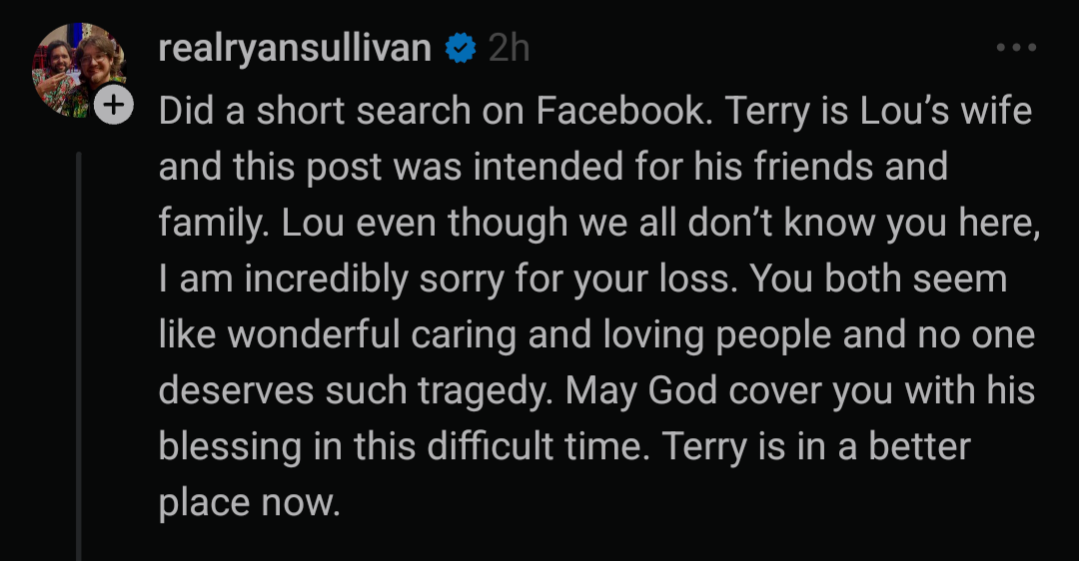
For those of us with public social media accounts: have you ever made a post with the assumption that your audience is the entire fucking world? No? Perhaps, like most people, you assumed that your audience would be the people who follow you.
Why do people think everything online is meant specifically for them?
More and more often, I’m seeing comments that seem to indicate that people think everything they see online is meant for them. We’re not the target audience for everything. If you don’t know who Terry is, it’s okay to scroll along.
But what’s going on with the people who can’t seem to keep scrolling without commenting?
My take is that the increased power of algorithms has led to an extreme siloing of perspective – basically the echo chamber effect x 100000. Remember when the first social media platforms arrived and people said if they product is free…then you’re the product? Here’s what that really means: if you can use a platform without paying, the platform is still making money somehow. They’re making money from advertisements. But why would a brand buy an ad on xyz platform? Because it will be shown to the people who are most likely to buy the product. Xyz platform knows who to show an ad to because they know who you are, what you like, and what you tend to buy. If they can prove to a potential advertiser that they have you (and everyone else on earth) pegged, they can sell their ad space at a higher rate. In order to do that, platforms like Facebook show potential advertisers your information – how old you are, where you live, your politics, whether or not you’re queer, have kids, and have a car. If you have pets – how many, what kind? If you’re into crafting or cars or vaping or acrylic nails or building miniatures or gardening or working out.
And once they know you and have sold a spot on your Instagram feed to an ad, they make sure you see only the things that will reinforce your worldview because it’s advantageous to them. The moooooore deeply you get sucked into gardeningTok, the more likely you are to make the purchase when you get an ad for gardening gloves on Instagram. The more deeply you dive into Brat summer, the more likely you are to click a Facebook ad for Troye Sivan. And when you’re clicking, advertisers are happy. Which means that Meta is happy, because with a strong track record of conversions (clicks & sales), their ad space increases in value, allowing them to sell a spot on your Insta feed for even more money in the next quarter.
We looooove being The Product
So if the platform is free, and we’re the product, then what? I think for most people, there’s a deep sense of comfort associated with being The Product. You don’t have to see things you don’t like, you don’t get offered music you don’t like, and you don’t see shows, TikToks, or Reels that you don’t like. You gain a community (of sorts) when you’re one of ten million “terminally-online bed-rotting mental healthTok girlies” as opposed to just a gal who should probably try getting a real, licensed therapist and some SSRIs.
In short, being The Product is comfortable. It’s easy. To use marketing lingo, it’s frictionless.
We crave the simplicity of the online world, and we seek to make the REAL world that simple, too.
RIP Terry x why don’t people buy tickets to shows?
As seen above, some people on the internet have become so accustomed to their entire internet experience being For Them that they can’t imagine someone posting something for someone else. They see something that doesn’t make sense and their first instinct is to ask wait, what about meeeeeeee?
There’s a lack of curiosity caused by this algorithmic funneling of people into increasingly tiny silos. It’s happening on every platform, and I think streaming platforms such as Spotify are one of the biggest perpetrators of this forced siloing. Listen to any algorithmic playlist and you’ll hear 38 versions of the same song over and over – and probably lots of repeats, too (this is a weird feature of Spotify – like….music is not finite). There’s no reason to be curious about a new artist. And if your curiosity has been suppressed enough that you won’t listen to a new artist (for $0) on Spotify, you sure as heck won’t spend $10-30 on a ticket to see them live.
But this is a trap that leads to a small life!
I’m not just saying this because I’m a musician. I don’t go to as many shows as I want to because I think a night in scrolling on my phone sounds cozier. But earlier this year I saw 13 bands in 7 days, and damn, I’ve never felt more alive. Most of them were bands I’d never even listened to online before.
The internet tricks us into thinking that it’s as good as the real thing. But let me say this in all caps:
A VIDEO OF A SHOW IS NOT A SUBSTITUTE FOR A SHOW
A RECORDING OF A SONG IS NOT HEARING IT LIVE
AN INSTAGRAM PHOTO IS NOT THE SAME AS SEEING SOMEONE
THE INTERNET IS NOT A REPLACEMENT FOR IRL EXPERIENCES
IN FACT, IT’S WORSE THAN IRL EXPERIENCES
(YET IT CLAIMS TO BE EQUAL OR BETTER)
A video is a great gateway to discovering a new artist or getting a glimpse into their live show, but it’s not the same thing. An artist whose recordings I love could give an even better show live. In an amazing twist, this summer I saw 3 people whose albums I honestly didn't’ really like – and they gave absolutely stunning performances. I’m still not streaming their albums, but I will 100% buy tickets to see all of them again.
If you’re not sold on an artist based on their online presence, gather up your curiosity (the animal part of you that’s still alive) and go to a show anyway. Unplug from the Amazon reviews, the Rotten Tomatoes reviews, the Yelp reviews, the Reddit reviews, the number of followers that an artist or a restaurant or a movie has online. Go find out with your eyes and your ears and your body.
The internet is amazing at connecting us over space and time in ways that even our grandparents found unfathomable as children. But it’s not a replacement for interacting with people in real life. I’m not a teacher any more so I’m not up on all the stats, but our younger generations are experiencing severe loneliness in record numbers, even though they’re ‘connected’ via their phones more than any other age group.
Grief can also lead to a small life.
My experience of grief in the United States of America has felt like an algorithm forcing me to slowly delete parts of myself until I can mindlessly slide down a little funnel back into the world of dog videos and makeup tutorials. Many of the people around me, who I care for deeply, mirror that – not responding when I mention my mom in a story. Freezing in awkwardness when I say her birthday’s coming up. Pushing the conversation to something else even if I say something as innocuous as “oh, my mom loved that song!”
As a result, I make my grief smaller, quieter.
But when it’s gotten to sing out, the connections that I’ve made truly shine. Whenever I’ve written about my mother and my grief, I hear from people who are grateful that I’m speaking about the topic at all. They’ll often say I can’t talk about my mom like that. I don’t know where to start. It’s been years now, no one wants to hear it. It’s so isolating. It’s good to know that someone understands. It’s so important for more people to talk about this.
Other people, who haven’t experienced loss, tell me things like this: this made me understand my mom better. I forget that my mom was living for the first time, too. I was suicidal once, too. Hearing your experience made me feel seen. It’s so important to talk about how depression can be hidden. Not enough people talk about mental health and grief intersecting.
I couldn’t help it if I tried. That’s just who I am – if I think it, I’ll write it. I’m grateful that it’s connected with other people. I think that’s proof that people want to live outside of an algorithmic everythings-made-for-me world. People want experiences that stretch and challenge them. And people know that if we are lucky, we will all grieve someone – many people. That it’s normal.
So why are people bent on fucking pathologizing grief?!?
Here’s the Threads reply that made me lose my mind.
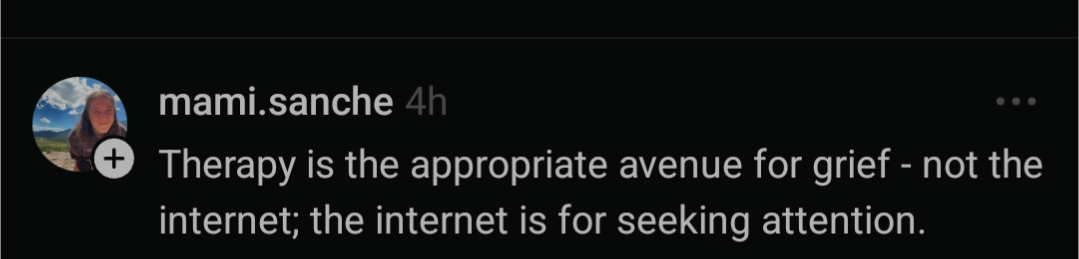
First of all, posting for attention is FINE. People wanting attention is FINE. Attention can be proof that we’re noticed, cared for, alive, existing.
Second of all, why are we pathologizing normal emotions that are meant to be felt collectively?
There’s this framework called the Social Model of Disability that states that disability is a social construct. The idea is that “able-bodied” bodies are grounded in the dominant power structure and that issues of access, inclusion, and prioritization of productivity are actually created by the power structures that exist (read about it better here).
Slightly similarly, American culture (and most Western cultures) has effectively pathologized grief – made it abnormal – by forcing it into the margins. There is nothing about grief that is wrong, bad, or embarrassing. Controversial in many grief support communities, the DSM-5 recently defined Prolonged Grief Disorder as a specific set of symptoms (including intense emotional pain, emotional numbness, feelings of isolation, and difficulty with reintegrating into ‘normal’ life) that persist longer than one year after experiencing a loss.
It is normal to be ill over death. Therapy is helpful for grief, but we should be able to lean on our communities as we move through it. Some Threads user feels like grief needs to stay off the internet and should hide in the quiet spaces of a therapist’s office? Makes me lose my mind. Any reverence for death and grief is too much to hope for from a random Threads user. That would have surprised me at one point, but not any more: for over a year now, we have seen footage that would have stopped the world in another era.
I’ve seen videos of children as they die in Gaza. I’ve seen photos of children’s bodies, torn apart, and their homes destroyed. Little grey feet sticking out from under piles of rubble bigger than my house. We’ve all seen it, and yet it continues, because those of us who’d rather not bear witness simply have to click on a few more cat videos to tell the algorithm no genocide content for me, thank you very much! Accounts that post frequently about the genocide get shadowbanned or taken down because it’s really destroying the vibe – scroll to the next Reel to see the craziest prank video hahahah!.
Emmett Till’s mother insisted that her son have an open-casket funeral because she wanted the world to see what had been done to her child. When a photo of his swollen, beaten body was published, it catalyzed the next stage of the Civil Rights Movement.
It’s easy enough to retreat back into the crafting video and workout tutorial algorithm feel-good while listening to a soundtrack of Whatever’s Big Right Now. Mmmm, feels good.
Get offline, think about death, and then go to a show.
Next week’s post will be happier, I promise.
Take a little bit of time today to notice what your algorithm’s feeding you. Do you actually want to see that stuff? Or have you, like me, sent someone a few too many Timothee Chalamet memes and now Instagram thinks you want MORE!?
Engage with the things you care about in the real world. If you love dogs, take your friend’s dog on a walk. If you love art, make some. If you love mental healthTok, go. to. a. real. therapist.
Then think about the end of life. Remember when you were a kid and you could remember so many things? The fact that you can’t remember much about your adult life isn’t a symptom of age (necessarily). It’s that we’ve outsourced our memory to our phones. I want to steal extra desserts from the kitchen at my nursing home while the rest of the residents control their ipads with the latest brain implant.
Okay, now go buy a ticket to a show for an artist you’ve never seen before. Listen to a song or two. Buy the ticket. Buy it now. Buy it in advance, not at the door. Then turn off your stupid phone!!!!!!!!!!!!!!!!!!!!!!!!!!!!!! And go to the show.
Feel stuff around other people. Cry or laugh as you will. Music, like grief, like life, is meant to be shared. Memento mori <3
Tl;dr
The internet is an echo chamber and the real world is getting more uncomfortable to be in because it’s not an echo chamber.
Stop obsessing over reviews and go to a show — it’s ok if it’s not what you expected or anticipated. That’s what it feels like to be curious and to learn new things.
Grief, life, and music are meant to be experienced in groups.
RIP Terry.